Short answer: the east coast has the famous beaches, resorts and islands and is the default route for first-timers; the west coast is drier, quieter and more culturally distinctive, and suits repeat visitors and slow travellers.
Quick comparison
| East Coast | West Coast | |
|---|---|---|
| Key stops | Haikou, Wenchang, Wanning, Lingshui, Sanya | Danzhou, Changjiang, Dongfang, Ledong |
| Beaches | Best-known beaches and bays | Fewer famous beaches, some excellent empty ones |
| Resorts | Dense, from budget to luxury | Sparse, more local guesthouses |
| Crowds | Busy in peak season | Quiet year-round |
| Culture | Tourism-oriented, some heritage sites | More local life, Li and Miao heritage, salt fields, old towns |
| Transport | High-speed rail along the coast, frequent services | Slower rail and road links, car strongly recommended |
| Climate | Wetter, greener | Drier, sunnier in the west |
| Best for | First-timers, beach holidays, families | Repeat visitors, road trippers, photographers, slow travel |
East coast: the classic Hainan route
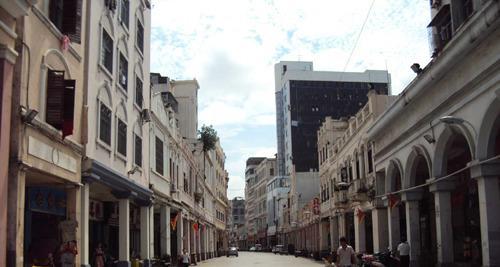
The east coast is what most people mean by "Hainan": Haikou's old streets, Wenchang's coconut countryside, Wanning's surf beaches, Lingshui's islands and Sanya's resort bays.
It has the highest concentration of tourism infrastructure on the island, connected by frequent high-speed trains and a good highway. You can move between cities in under an hour and find accommodation at every price point.
The trade-off is that in peak season the east coast is crowded and prices are high, and some beach areas feel heavily commercialised.
West coast: quieter, drier, more local
The west coast runs through Danzhou, Changjiang, Dongfang and Ledong. It is drier and sunnier than the east, with fewer tourists and a stronger sense of everyday Hainan life.
Highlights include old salt fields, traditional villages, volcanic landscapes inland, and long stretches of empty coastline. Danzhou has a substantial food culture and historic sites, and the region is home to significant Li and Miao communities.
The trade-off is logistics: high-speed rail coverage is thinner than on the east, attractions are further apart, and English is less widely spoken. A car, or a driver, transforms the experience.
Who should choose which
- First trip to Hainan → east coast
- Beach-focused holiday → east coast
- Families with children → east coast (facilities, hospitals, resorts)
- Repeat visitors → west coast
- Road trippers and photographers → west coast
- Travellers interested in local culture and food → west coast
Practical notes
Hainan's high-speed rail loop connects both coasts, but services and stations are denser on the east. Renting a car is the most practical way to explore the west, and is worth considering for the east too if you want to reach beaches away from the main towns.
If you have a week or less, do the east coast properly rather than rushing both. If you have two weeks, a loop combining both coasts is one of the best road trips in southern China.